The Business Case for Sustainability: How to Evaluate ROI on Environmental Initiatives
Sustainability initiatives can support business performance when they address real operational needs and produce outcomes an organization can measure. Energy efficiency, waste reduction, and better risk management may lower operating costs or strengthen resilience, but returns depend on the project, its implementation, and the time horizon.
A credible business case connects environmental goals with organizational priorities, tracks both costs and benefits, and states what remains uncertain. That approach helps decision-makers compare initiatives on evidence rather than assuming every green investment will pay for itself quickly.
Why sustainability belongs in business planning
Sustainability belongs in business planning because environmental priorities can affect operating costs, supply continuity, regulatory exposure, and stakeholder relationships. Integrating them into core decisions makes it easier to identify risks and opportunities early.
A sustainability strategy should link environmental initiatives to goals that matter to the organization. For a manufacturer, that might mean reducing energy use per unit produced. For a property operator, it could mean lowering building energy demand while maintaining comfort. In each case, the environmental target sits alongside operational measures such as cost, output, and reliability.
This connection also improves planning. A facility upgrade may require capital now but reduce exposure to energy-price changes over time. A waste-prevention program may improve material use while requiring staff training and process adjustments. The financial case will differ by site and sector, so organizations should test assumptions rather than rely on broad claims.
Start with the business problem as well as the environmental goal. Ask what is driving the proposal: high utility bills, material loss, supply-chain vulnerability, customer requirements, or a stated emissions target. When a project addresses a defined need, leaders can assess it against existing priorities and compare it with other uses of capital.
Where environmental initiatives may create business value
Environmental initiatives may create business value through lower resource use, improved process efficiency, reduced exposure to risk, and stronger stakeholder engagement. The scale and timing of those benefits vary, so each proposal needs project-specific evidence.
Energy efficiency can reduce electricity or fuel demand through measures such as equipment upgrades, building controls, maintenance, or process redesign. The business case should account for installation costs, expected energy use, operating schedules, and any effect on production or occupant comfort. Savings may be smaller than forecast if equipment runs less often than expected or if performance is not maintained.
Waste reduction can limit spending on materials, disposal, and rework. Tracking scrap or waste by process helps identify where prevention is practical. A reuse or recycling option may still involve collection, sorting, storage, and transport costs, so compare its full operating requirements with the current approach.
Environmental initiatives can also support risk management. Mapping dependence on water, energy, raw materials, or vulnerable suppliers can reveal where disruption could interrupt operations. Mitigation may not produce a simple annual saving, but decision-makers can evaluate its potential value by considering the likelihood and consequence of a disruption, while being clear that forecasts are uncertain.
There may be stakeholder benefits as well. Employees, customers, investors, suppliers, and communities can respond to credible environmental performance and transparent reporting. These outcomes can matter strategically, but they should not be presented as guaranteed revenue or reputation gains without supporting evidence.
How to assess sustainability ROI
To assess sustainability ROI, define the objective, establish a baseline, record all relevant costs, measure outcomes, and choose a time horizon that matches the initiative. Compare results with a reasonable alternative, not just with doing nothing.
- Define the objective. State the environmental result and business outcome. For example: reduce electricity use in a specific facility while maintaining its operating requirements.
- Establish a baseline. Record current energy, water, material, or waste use and the conditions that affect it, such as production volume, weather, occupancy, and operating hours. Use a consistent period and data source.
- Capture the full cost. Include equipment or design, installation, staff time, training, maintenance, measurement, financing, and any disruption during implementation. Separate one-time investment from recurring expenses.
- Measure outcomes over time. Track financial results and environmental performance after launch. Compare like with like, and document changes in activity that could explain the results.
- Test the alternatives. Compare the initiative with the current process and, where useful, another feasible option. Include uncertainty in estimates for prices, performance, and project life.
A basic financial measure is net benefit over a stated period: estimated financial benefits minus implementation and operating costs. An organization can also calculate payback period or net present value if those measures fit its capital-planning practice. No single formula captures every environmental or operational outcome, so state what is included and what is not.
For example, a facility team considering lighting controls might compare the current electricity baseline with post-installation use, adjust for operating hours, and include hardware, commissioning, and maintenance costs. If use falls, the team can report the observed change and explain whether production or occupancy also changed. That distinction makes the result more useful than attributing every difference to the project.
Choosing useful metrics and making trade-offs visible
Useful sustainability metrics pair financial measures with environmental outcomes and implementation demands. This combination shows whether a project is affordable, operationally effective, and delivering the environmental result it was designed to achieve.
Choose a small set of measures tied to the project. Depending on the initiative, they may include:
- Energy use and energy cost, reported in consistent units and over comparable periods.
- Waste generated, diverted, or avoided, with clear definitions for each category.
- Water or material use per unit of output, where production volume changes over time.
- Capital expenditure, operating costs, maintenance needs, and estimated payback.
- Operational indicators such as downtime, product quality, or equipment reliability.
- Risk indicators, such as dependence on a constrained resource or exposure to supply disruption.
Pair absolute totals with intensity measures when activity levels fluctuate. Total energy use may rise because production increased, even while energy use per unit fell. Reporting both figures helps avoid a misleading interpretation and gives managers a clearer view of performance.
Trade-offs should be visible. A lower-impact material may cost more or need different handling. A retrofit may reduce energy consumption while requiring downtime or specialized maintenance. Explain who bears each cost, when it occurs, and whether the project creates constraints elsewhere. Transparent assumptions make a sustainability assessment easier to challenge and improve.
Building a credible business case
A credible business case presents the proposed initiative, expected outcomes, costs, assumptions, risks, and measurement plan in language decision-makers can compare with other investments. It distinguishes verified data from estimates and avoids promising returns that have not been demonstrated.
Keep the proposal focused. Summarize the operational or environmental need, the recommended action, the investment required, and the measures that will show whether it worked. Then explain the time horizon: some benefits may appear quickly, while equipment life, procurement changes, or resilience improvements require longer evaluation.
Include a base case and a range of plausible outcomes. For instance, show how the financial result changes if energy prices, utilization, installation costs, or equipment performance differ from the central estimate. Identify the largest uncertainties and who will monitor them. This is more useful than presenting a single precise-looking figure built on fragile assumptions.
Common errors weaken otherwise sound proposals:
- Counting only purchase price: This misses training, maintenance, monitoring, and implementation disruption. Use a full-cost view.
- Using an unreliable baseline: A short or unrepresentative period can distort expected savings. Document the baseline and adjust for material changes in activity.
- Monetizing every benefit: Some outcomes, including stakeholder trust or avoided disruption, are difficult to value precisely. Report them separately with evidence and a clear explanation.
- Ignoring ownership after launch: Without a person responsible for measurement and upkeep, expected performance can drift. Assign accountability before approval.
Close with a decision request: approve funding, authorize a pilot, or commission more analysis. For uncertain projects, a staged pilot can limit exposure while producing local evidence. Its trade-off is that pilots may not capture the costs or complications of scaling across multiple sites.
Learning from peers at environmental conferences
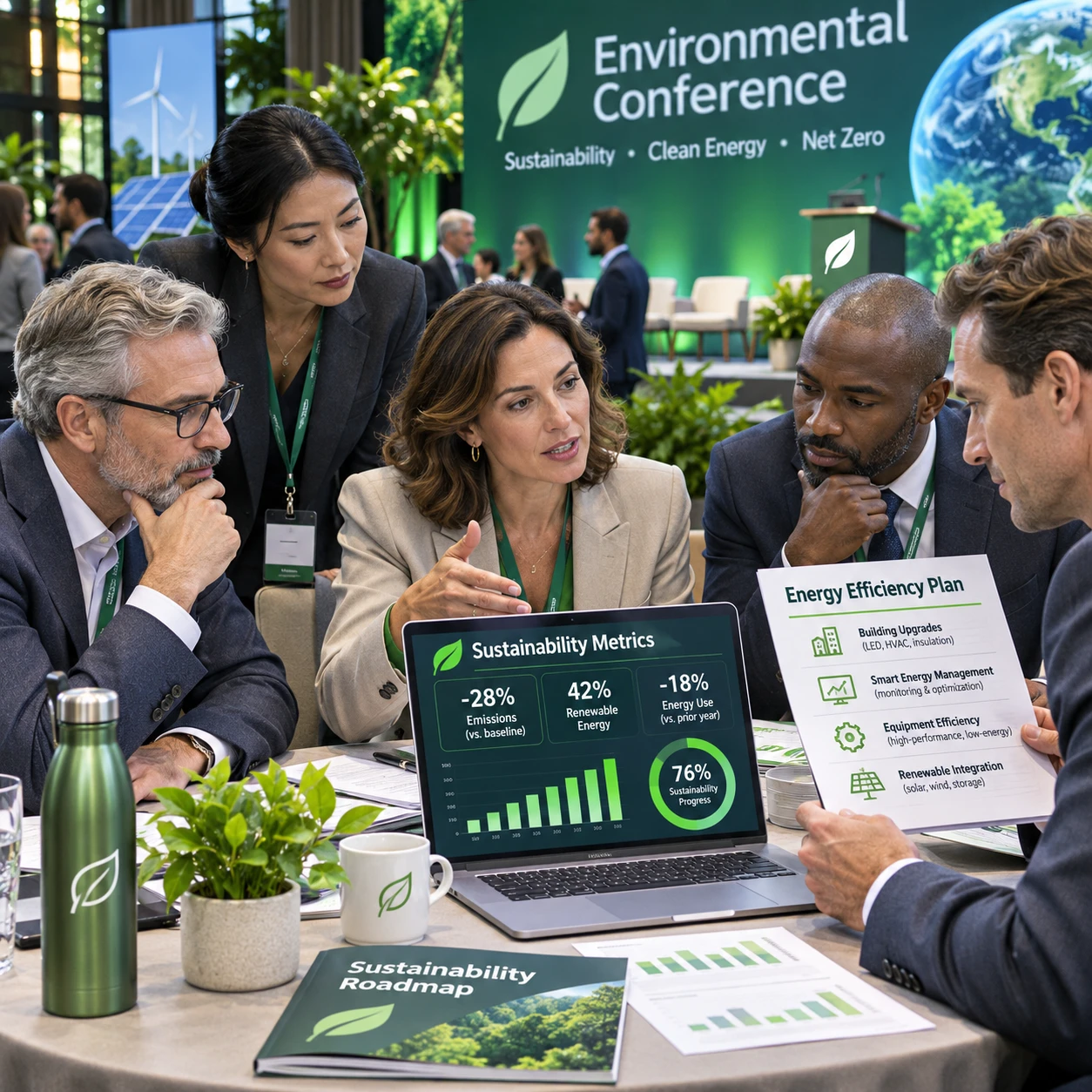
Environmental conferences can support sustainability planning by giving teams access to peer experience, technical discussions, and lessons from implementation. They help inform a business case, but conference insights should be tested against local operating conditions.
Use the event with a defined question in mind. A facilities manager might seek practical data on energy controls; a procurement lead may want to understand supplier measurement methods; a finance team could compare approaches to valuing long-term risk. Focused conversations make it easier to bring back information that can improve project assumptions.
Ask peers what their projects actually required: capital and staff time, maintenance arrangements, measurement methods, setbacks, and the period needed to observe results. A case study’s savings may depend on building design, energy prices, climate, or operating patterns that differ from yours. Treat it as a source of questions, not a forecast.
After an environmental conference, document the most relevant findings, identify what needs verification, and assign a next step. That might be checking a vendor claim, contacting a peer about measurement details, or running a baseline study. Peer learning has value when it sharpens decisions and helps organizations learn from implementation, including projects that delivered less than expected.
In the end, the business case for sustainability is strongest when financial discipline and environmental measurement work together. Clear baselines, complete cost accounting, realistic time horizons, and honest uncertainty give decision-makers a sound basis for action.