Sustainable Supply Chain Management: Best Practices and Challenges
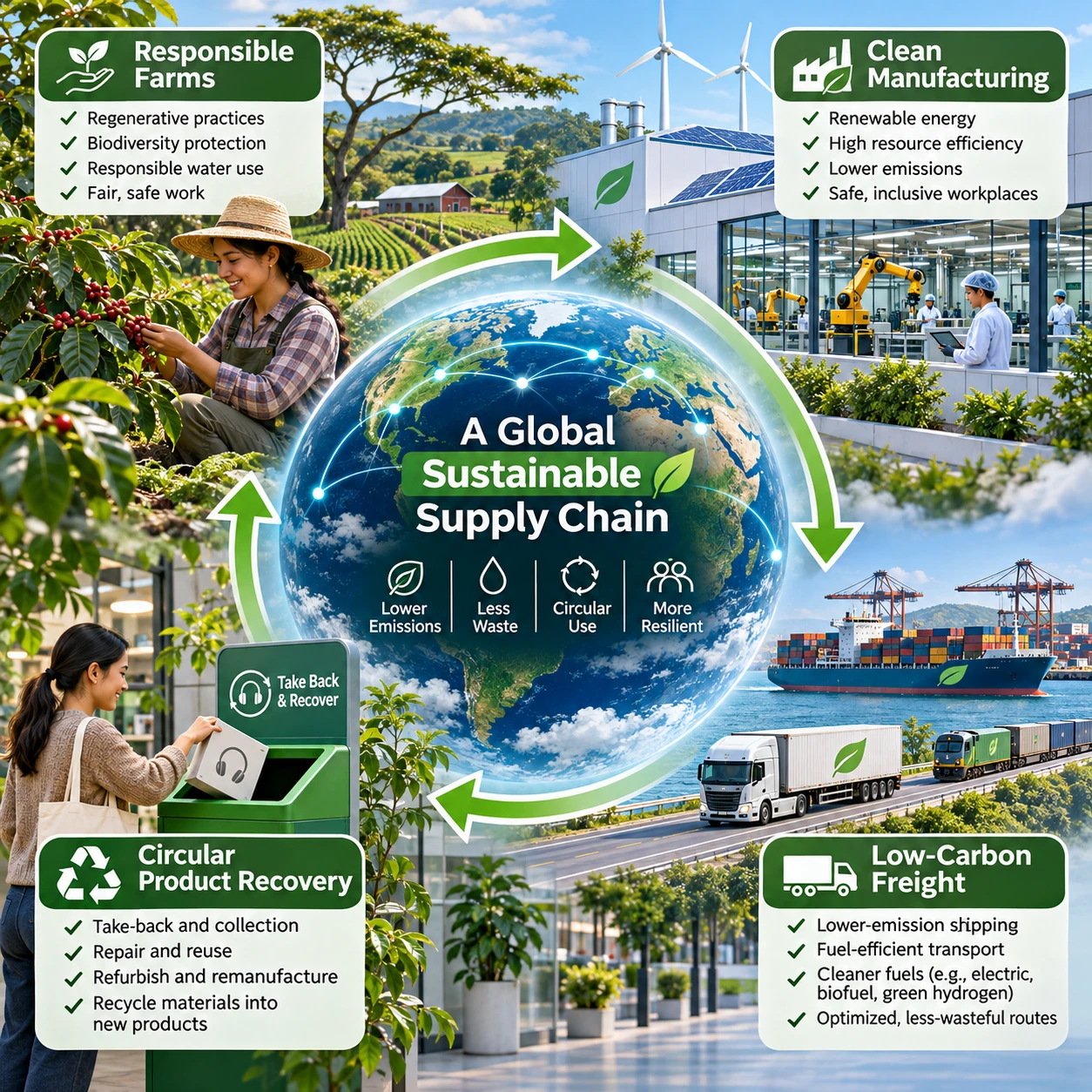
Sustainable supply chain management helps organizations reduce environmental and social harms across the goods and services they buy, make, move, use, and recover. It takes more than a carbon target: progress depends on responsible sourcing, supplier relationships, credible data, and decisions that account for the full life cycle of a product.
What Sustainable Supply Chain Management Involves
Sustainable supply chain management integrates environmental, social, and governance (ESG) considerations into sourcing, production, transport, and end-of-life decisions. It gives a company a way to identify impacts across its value chain and work with suppliers to improve them.
The scope extends beyond a company’s own facilities. It can include raw-material extraction, labor conditions at suppliers, manufacturing energy and water use, packaging, freight, product durability, and disposal or reuse. A life-cycle assessment (LCA) can help identify where impacts occur, though its findings depend on the quality and boundaries of the data.
Climate is one part of the picture. A responsible approach also considers issues such as pollution, biodiversity, water stress, worker safety, human rights, and waste. Priorities vary by sector: a food company may focus on land use and agricultural practices, while an electronics producer may examine minerals, product repair, and e-waste.
Why It Matters for Business and the Environment
Sustainable supply chain management can reduce environmental impacts while improving visibility, resilience, and responsible business practices. Its value depends on choosing actions that address material risks rather than treating sustainability as a checklist.
Supply chains can account for a substantial share of an organization’s greenhouse gas emissions, often reported as Scope 3 emissions. These indirect emissions arise from activities such as purchased goods and services, upstream transport, and product use or disposal. Mapping them can reveal opportunities that operational energy targets alone miss.
Environmental and social risks can also disrupt supply. Water scarcity, extreme weather, resource shortages, and labor violations may affect costs, access to materials, or continuity. Understanding supplier locations and dependencies gives teams more time to prepare, although measurement itself cannot eliminate these risks.
There is a business case in better purchasing information, reduced material waste, and stronger relationships with suppliers. But sustainable choices can involve upfront costs, longer lead times, or trade-offs between competing goals. A recycled material, for example, may lower demand for virgin resources but require testing to meet product performance and safety requirements.
Best Practices for Building a Sustainable Supply Chain
Build a sustainable supply chain by setting clear expectations, prioritizing high-impact suppliers, and collaborating on improvements that can be measured. Start with the parts of the value chain where the company has the greatest impact or exposure.
Set standards and engage suppliers
Translate ESG criteria into practical supplier standards covering topics such as emissions, energy, water, waste, worker rights, and business integrity. Apply a risk-based approach: consider spend, geography, material type, and known environmental or labor concerns rather than demanding the same depth of evidence from every vendor.
Supplier engagement works better as an ongoing conversation than a one-time questionnaire. Explain why information is needed, provide a consistent reporting template, and agree on achievable improvement plans. For smaller suppliers, technical guidance or shared tools may be more effective than penalties for incomplete data.
Use life-cycle thinking and circularity
Use life-cycle assessment to compare materials, designs, and delivery options across relevant stages. Keep assumptions consistent, and avoid presenting a single impact measure as a complete verdict. LCA can guide decisions, but it is not a substitute for due diligence on labor or sourcing conditions.
Apply circular economy principles where they fit: reduce material use, design products for durability and repair, reuse components, and recover materials at end of life. Circularity depends on workable collection, repair, and recycling systems; a recyclable design has limited value if those systems are unavailable.
Reduce emissions and improve sourcing
For emissions, identify major Scope 3 categories, improve activity data, and work with suppliers on energy efficiency, renewable electricity, materials, and freight. Responsible sourcing can include traceability for high-risk commodities and verification that purchasing practices do not undermine supplier improvements.

Common Challenges and How to Address Them
The most common challenges are incomplete data, cost pressure, complex supplier networks, and limited influence over suppliers. Companies can make progress by narrowing priorities, improving information in stages, and treating suppliers as partners where possible.
- Data gaps: Suppliers may use different definitions, systems, or reporting periods. Set a clear baseline and request a small, consistent set of fields first, such as energy use, emissions, water, and waste. Mark estimates as estimates; false precision weakens decisions.
- Cost and procurement pressure: Sustainable materials or audits may add cost, while buyers still negotiate on price and delivery. Include life-cycle costs and sustainability criteria in procurement decisions, and avoid asking suppliers to invest without considering contract length or pricing.
- Complex networks: A company may have little direct visibility beyond tier-one suppliers. Map critical materials and high-risk regions first, then extend traceability where it can change decisions. Full mapping can be expensive and may not be practical for every product.
- Limited leverage: A smaller buyer may have little power to change a large supplier’s practices. Join sector initiatives, coordinate requests with other customers, and focus on specific changes the supplier can implement. Escalation or disengagement may be necessary for serious, unresolved violations, but abrupt exits can also harm workers if handled poorly.
A frequent mistake is setting ambitious targets before establishing a credible baseline. Another is relying only on supplier self-assessments. Use documentation, risk-based checks, and follow-up conversations to validate key claims without assuming that every supplier needs an expensive audit.
Measuring Progress and Improving Over Time
Measure sustainable supply chain progress with a focused set of sustainability metrics, regular reviews, and transparent reporting. Choose indicators that connect to identified impacts and show whether actions are producing change.
Useful measures may include:
- Scope 3 emissions by relevant category, alongside the share based on primary supplier data.
- Supplier coverage for ESG assessments, and the proportion of high-risk suppliers with improvement plans.
- Energy, water, waste, and recycled or responsibly sourced material use in priority supply chains.
- Corrective-action completion and, where appropriate, indicators related to worker safety and labor standards.
Pair outcome measures, such as emissions or water use, with activity measures, such as supplier training or renewable-energy adoption. Activity alone does not prove impact, but it can explain why results are changing. Report boundaries, methods, estimates, and year-over-year comparisons so readers can interpret the figures.
Review performance at least annually and more often for high-risk commodities or fast-changing operations. If a metric stalls, investigate whether the issue is weak supplier participation, an unrealistic target, poor data, or a purchasing practice that creates conflicting incentives. Then adjust the plan and document why.
The Role of Collaboration and Knowledge-Sharing
Collaboration helps companies tackle supply-chain problems that no single buyer can solve efficiently. Environmental conferences and cross-sector forums can support practical progress when participants share methods, compare challenges, and follow up with joint action.
Useful collaboration might include harmonizing supplier questionnaires, developing shared traceability approaches, or exchanging lessons on life-cycle assessment and Scope 3 accounting. Public agencies, industry groups, researchers, suppliers, and civil-society organizations can bring different evidence and perspectives. Shared learning is especially valuable for smaller organizations that lack dedicated sustainability teams.
Conferences are a starting point, not an implementation plan. Teams should leave with a specific next step: a supplier pilot, a data-definition change, or a partner to consult. They should also consider whose voices are missing, particularly workers and smaller suppliers who experience the effects of procurement decisions directly.
Frequently Asked Questions
What is sustainable supply chain management?
It is the practice of managing environmental, social, and governance impacts across sourcing, production, transport, and product end-of-life. It includes work with suppliers as well as actions within a company’s own operations.
How can a company evaluate supplier sustainability?
Set clear ESG criteria, prioritize suppliers by impact and risk, gather consistent evidence, and use follow-up checks for material concerns. Pair assessment with supplier engagement and improvement plans rather than relying on scores alone.
What are common barriers to implementation?
Common barriers include limited or inconsistent data, cost constraints, complex supplier networks, and low leverage over suppliers. Prioritization, shared standards, realistic contracts, and industry collaboration can help address them.
Which metrics can help track progress?
Useful metrics include relevant Scope 3 emissions, supplier assessment coverage, corrective-action progress, water and waste indicators, and responsible-material sourcing. Report the boundaries and data quality behind each measure.