How to Measure and Reduce Your Organization's Carbon Footprint: A Practical Guide

Why Carbon Footprint Measurement Matters for Organizations Today
You cannot reduce what you haven't measured. That's the blunt reality behind every credible organizational sustainability program, and it applies equally to a multinational corporation and a three-day environmental conference. Before any reduction target makes sense, a verified picture of current emissions has to exist.
The stakes have shifted considerably. Regulators in the EU, UK, and increasingly in North America are tightening sustainability reporting requirements. Investors screen ESG disclosures before committing capital. And for organizations in the events space — conference venues, delegate-heavy gatherings, hospitality-intensive summits — the carbon profile of a single event can rival a small office's annual output, particularly once delegate travel enters the picture.
Measurement also creates accountability. Without a documented baseline, claims of environmental leadership are difficult to substantiate and easy to dismiss as greenwashing. Getting the numbers right is the foundation everything else rests on.
Understanding the Three Scopes of Organizational Emissions
Scope 1, 2, and 3 emissions are the three categories used to classify every source of greenhouse gas an organization is responsible for, either directly or indirectly. Understanding the distinction between them determines what you measure, who owns the data, and where the biggest reduction opportunities sit.
- Scope 1 covers direct emissions from sources your organization controls — on-site combustion, company-owned vehicles, fugitive gases from refrigeration systems. For a conference venue, this includes gas-fired heating and any owned transport fleet.
- Scope 2 covers indirect emissions from purchased electricity, heat, or steam. Switching to a renewable energy procurement contract is the most direct lever here, and it can reduce reported Scope 2 emissions to near zero on paper — though the physical grid reality is more nuanced.
- Scope 3 is everything else: delegate and staff travel, catering supply chains, waste, purchased goods and services, and the emissions embedded in your vendors' operations. For most event-based organizations, Scope 3 accounts for 70–90% of total emissions, with air travel typically the single largest contributor.
The temptation is to focus only on Scope 1 and 2 because the data is easier to collect. Resisting that temptation matters — ignoring Scope 3 means ignoring most of the problem.
How to Conduct a Carbon Footprint Baseline Assessment
A carbon footprint audit starts with a data-gathering exercise across every emission source identified in your scope boundaries. The quality of your baseline determines the credibility of every target and reduction claim that follows.
Begin by defining your organizational boundary: which sites, activities, and subsidiaries are included? Then collect the following primary data sources:
- Energy bills — 12 months of electricity, gas, and fuel consumption records for all owned or leased spaces
- Travel logs — flight records (origin, destination, cabin class), rail and road mileage, hotel nights for staff and, where feasible, delegates
- Procurement records — invoices for catering, printed materials, AV equipment hire, and logistics
- Waste data — tonnage by disposal route (landfill, recycling, composting)
Apply published emission factors — from national government databases or the IPCC — to convert activity data into tonnes of CO₂ equivalent (tCO₂e). This is the standard unit across all reporting frameworks.
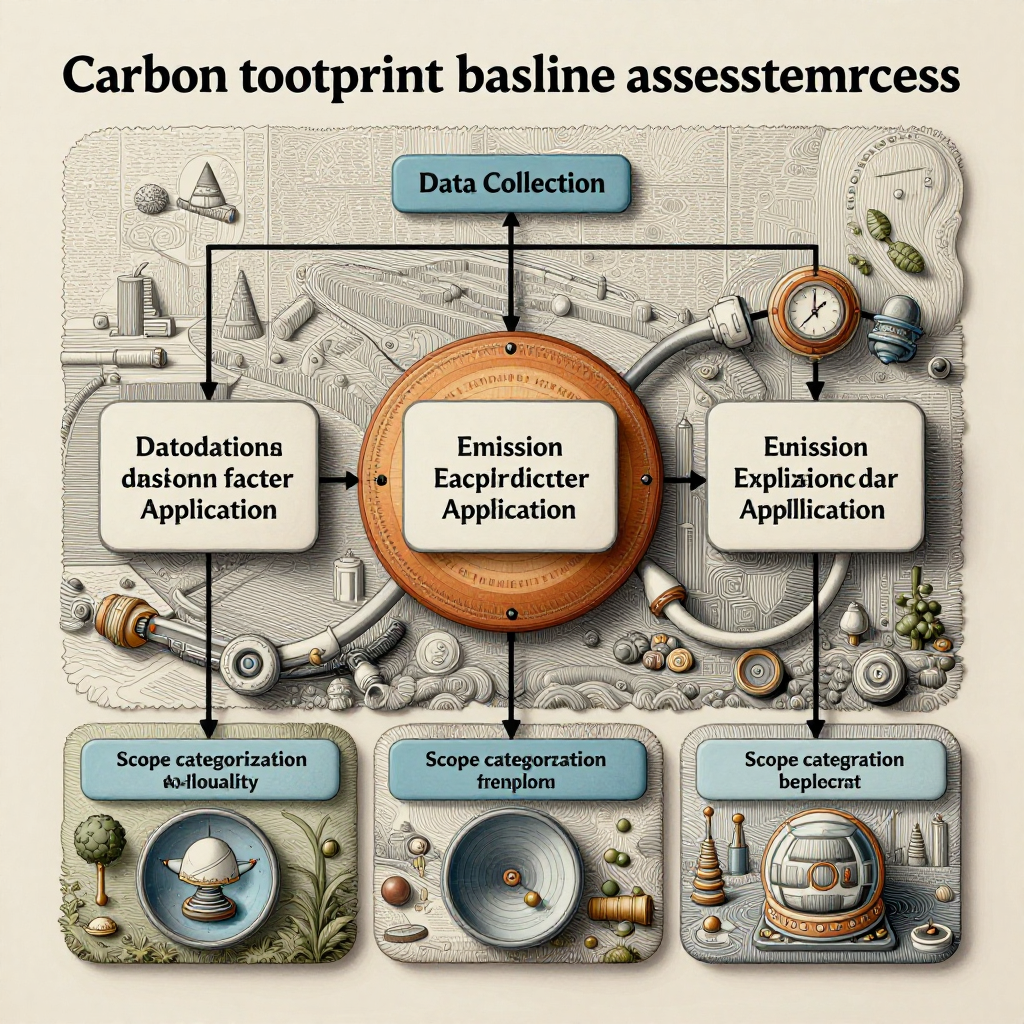
For a first assessment, gaps in data are normal. Use spend-based estimates as proxies where primary activity data isn't available, but flag them clearly. Transparency about methodology is part of what makes a baseline credible.
Choosing the Right Measurement Framework and Tools
The GHG Protocol is the global standard for organizational carbon accounting, and it's the framework that underpins most national regulations and voluntary disclosure schemes. Starting here — rather than with a proprietary tool — ensures your methodology is defensible and comparable across years and organizations.
The GHG Protocol's Corporate Accounting and Reporting Standard provides detailed guidance on scope definitions, boundary-setting, and emission factor selection. It's freely available and designed to be applied without specialist software, though calculation tools ranging from spreadsheets to dedicated platforms can streamline the process.
Once you have a baseline, Science-Based Targets (SBTi) offer a rigorous framework for setting reduction goals aligned with the Paris Agreement's 1.5°C pathway. SBTi validation requires covering Scope 1, 2, and material Scope 3 categories, which is why the baseline work matters so much upfront. Targets validated by SBTi carry significantly more credibility with external stakeholders than self-declared goals.
For smaller organizations or single events, a full SBTi submission may not be proportionate. In those cases, applying GHG Protocol methodology consistently year-over-year and publishing the results is a solid, honest approach.
High-Impact Strategies to Reduce Your Organization's Emissions
Reduction strategies work best when prioritized by emission magnitude — tackle the biggest sources first, not the easiest ones. Based on typical organizational profiles, the highest-impact areas are energy consumption, travel, and supply chain emissions.
Energy and Facilities
Switching to a certified renewable energy tariff or installing on-site generation addresses Scope 2 directly. Beyond procurement, operational efficiency measures — LED lighting, smart HVAC controls, better insulation — reduce the absolute consumption that renewable contracts have to cover. For venues, energy intensity per delegate-day is a useful metric to track.
Travel and Events
Delegate travel is where conference organizations face their hardest trade-off: in-person gatherings generate value that virtual formats don't fully replicate, but long-haul flights carry substantial carbon costs. Practical levers include consolidating international events to reduce total flight frequency, prioritizing rail for journeys under four hours, offering hybrid participation for remote delegates, and publishing a clear travel hierarchy in delegate communications.
Supply Chain and Procurement
Engaging supply chain emissions means asking vendors for their own carbon data and weighting procurement decisions partly on environmental performance. For catering — a significant Scope 3 source — shifting toward plant-forward menus and locally sourced ingredients can reduce embedded emissions by 30–50% compared to conventional event catering, based on lifecycle assessment data for food categories.
Tracking Progress and Reporting Reductions Credibly
Setting KPIs for emissions tracking before your first reduction year ensures you're measuring change against a consistent baseline rather than shifting the goalposts. The most useful metrics combine absolute figures (total tCO₂e) with intensity ratios (tCO₂e per delegate, per event, or per £ revenue) to separate genuine reduction from changes in organizational scale.
Build a reporting cadence that matches your operational cycle. For event organizations, an annual report published within three months of the event season closing is realistic. Include:
- Year-on-year comparison against the baseline year
- Progress toward any stated targets (SBTi or otherwise)
- Methodology notes, including any changes to scope or emission factors
- Actions taken and their estimated impact
Transparent ESG disclosure — whether through a standalone sustainability report, a CDP submission, or an integrated annual report — builds stakeholder trust precisely because it acknowledges where progress is slower than planned. Organizations that only report good news tend to lose credibility faster than those that report honestly.
When and How to Use Carbon Offsets Responsibly
Carbon offsets should come last, not first. They are a mechanism for addressing residual emissions that cannot yet be eliminated through operational changes — not a substitute for doing the harder work of actual reduction.
The distinction between carbon neutrality and net zero matters here. Carbon neutrality typically means balancing emissions with an equivalent volume of carbon credits in a given year, without necessarily reducing the underlying emissions. Net zero, as defined by the Science-Based Targets initiative's Net-Zero Standard, requires deep absolute reductions (90%+ across all scopes) before any offsetting of remaining emissions. Calling an event "carbon neutral" via offsets alone is technically defensible but strategically weak — it doesn't demonstrate the trajectory toward genuine decarbonization.
If offsets are part of your strategy, prioritize high-quality carbon credits with independent verification (Gold Standard or Verra's VCS are the most widely recognized standards). Nature-based projects carry permanence risks; technology-based removals like biochar or direct air capture are more durable but currently more expensive. Be specific in communications about what has been offset, what standard was applied, and what the organization is doing to reduce reliance on offsets over time.
Frequently Asked Questions
What is the difference between carbon neutral and net zero?
Carbon neutrality means balancing current-year emissions with an equivalent volume of offsets, without requiring deep operational reductions. Net zero, under the SBTi Net-Zero Standard, requires reducing absolute emissions by at least 90% across all scopes before neutralizing any remainder. Net zero represents a fundamentally stronger commitment.
How long does it take to complete an organizational carbon audit?
A first baseline assessment typically takes four to twelve weeks, depending on organizational complexity and data availability. Most of that time is spent gathering and cleaning activity data rather than performing calculations. Subsequent annual updates are significantly faster once data systems are in place.
Do small organizations or single events need to measure all three scopes?
Technically no, but practically yes for material sources. A small conference that ignores delegate air travel is omitting its largest emission source. The goal is to cover all significant sources, even if the methodology for Scope 3 relies on estimates rather than primary data.
What data do we need before starting a carbon footprint assessment?
At minimum: 12 months of energy bills, a travel log with distance and mode for all business travel, procurement spend by category, and waste tonnage by disposal route. Delegate travel data requires either a booking system or a post-event survey. More data improves accuracy, but a reasonable estimate is better than no measurement at all.
How often should an organization update its carbon footprint measurement?
Annually is the standard for ongoing organizations. Event-based organizations should measure per event and aggregate annually. Updating more frequently is rarely necessary unless a major operational change — a new venue, a change in energy supplier, a shift in event format — warrants an interim recalculation.