Case Study: A Zero-Waste Event – From Planning to Execution
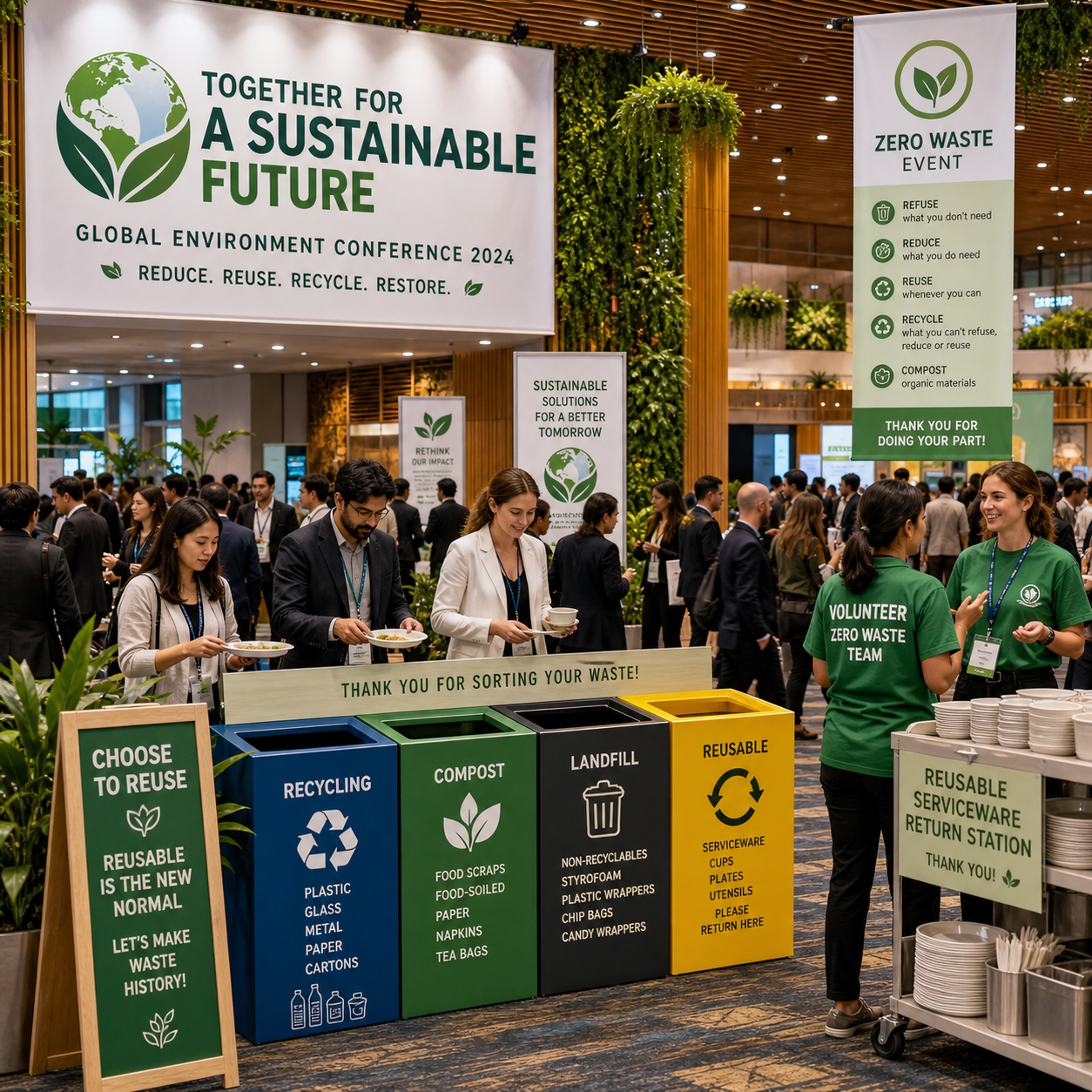
A zero-waste event begins long before the first attendee arrives. For this case study, an environmental conference used the waste hierarchy to guide decisions from venue procurement through post-event measurement. The objective was to prevent waste wherever possible, reuse materials and equipment, and send unavoidable residuals to appropriate recycling or composting systems.
The project did not assume that every item could be eliminated. Instead, organizers defined success through documented prevention, high-quality sorting, supplier cooperation, and transparent reporting. That distinction matters: recycling alone does not make an event zero waste, and a sustainability claim is only credible when planned performance is compared with actual results.
Setting the Zero-Waste Event Goals
A zero-waste event needs a written definition, a baseline waste audit, and measurable success criteria. The conference team treated zero waste as a design target based on prevention, reuse, recovery, and honest disclosure of materials that remained.
The first planning meeting established four objectives:
- Prevent unnecessary materials from entering the venue.
- Replace single-use items with reusable or returnable alternatives.
- Separate food scraps, recyclables, and residual waste at the point of disposal.
- Measure results by waste stream rather than relying on impressions.
Organizers then completed a baseline waste audit using records from a comparable previous conference. They reviewed the number of attendees, catering covers, exhibitor materials, disposable cups, printed documents, food leftovers, and general waste collected. Where historical records were incomplete, the team marked estimates clearly instead of presenting them as measured facts.
The waste hierarchy became the decision filter: refuse and reduce first, reuse next, recycle and compost after that, and dispose only as a last resort. A useful approval question was, “Can this material be avoided, borrowed, returned, or used again?” If the answer was no, the team examined whether a verified local recovery route existed.
Success criteria included a completed waste-stream log, documented supplier compliance, contamination checks, attendee participation, and a post-event review. The organizers deliberately avoided unsupported claims such as “100% zero waste.” Their final report would distinguish between planned diversion, actual recovery, avoided purchases, and residual disposal.
Planning the Event Around Waste Prevention
Planning around waste prevention means making low-waste decisions before purchasing begins. Venue selection, registration, communications, materials, and supplier contracts were treated as parts of one circular economy system rather than separate tasks.
Choosing the venue and reducing materials
The preferred venue already had clearly documented recycling and organics collection, a loading area for reusable equipment, washable kitchenware, water refill points, and a caterer familiar with waste separation. This reduced the need to introduce temporary systems under time pressure. The venue’s waste contractor also explained where each material went after collection, allowing the team to identify gaps before signing.
Registration was digital, with QR-code schedules and downloadable session information. Name badges used a return box at the exit, while directional signs were printed on durable boards that could be updated and reused. Speakers received a digital briefing instead of branded folders, and exhibitors were asked to avoid giveaways, foam displays, and individually packaged promotional items.
Procurement documents included specific requirements for event suppliers. Contracts covered packaging take-back, delivery consolidation, reusable transport crates, accurate invoices for materials, and advance notice of substitutions. This approach shifted responsibility upstream. A supplier could not quietly replace a reusable item with a disposable one without approval.
There were trade-offs. Digital communication reduced paper, but it increased dependence on battery-powered devices and accessible internet. The team kept a small reserve of printed accessibility materials and a limited number of paper schedules for people who requested them. Prevention worked best when it remained inclusive rather than absolute.
Designing Sustainable Catering and Serviceware
Sustainable catering reduces waste through accurate portions, seasonal menu design, surplus planning, reusable serviceware, and separate organics collection. The caterer’s operating plan covered food before service, during the meal, and after the event.
Attendance data was shared with the caterer in stages. A provisional headcount supported early purchasing, while registration close dates and on-site confirmation improved the final order. Instead of offering large trays of every dish throughout the day, the kitchen replenished smaller batches. This protected food quality and limited leftovers when session attendance changed.
The menu favored plant-forward dishes, local availability, and ingredients that could be used across several recipes. For example, roasted vegetables could appear in a lunch bowl, a salad, and a late-day soup. The purpose was not to impose a particular diet. It was to simplify purchasing, use ingredients efficiently, and avoid fragile menu items that generated avoidable spoilage.
Reusable serviceware replaced disposable plates, cups, cutlery, and serving utensils. A collection point near the exit made returns convenient, while the venue’s washing area handled cleaning in controlled batches. Where reusable items were unavailable, organizers selected packaging only after checking local recycling or composting capacity. A product labeled biodegradable would not automatically qualify if the local facility could not process it.
Food waste was separated from packaging at back-of-house stations. Clearly marked containers received preparation scraps and post-service organics, while staff removed contamination before collection. Safe, untouched surplus was handled according to the caterer’s food-safety procedures, such as redistribution through an established community partner when practical. No donation promise was made without confirming storage, transport, and legal requirements.
Portion management required tact. Smaller default portions with easy seconds reduced plate waste without making attendees feel restricted. Dietary labels also prevented people from taking food they could not eat. The main lesson was operational: sustainable catering depends as much on forecasting and staff communication as on the menu itself.
Coordinating Suppliers, Staff, and Attendees
A zero-waste event succeeds when every participant knows what to do, when to do it, and who owns the decision. The conference assigned responsibilities to event suppliers, venue staff, volunteers, speakers, exhibitors, and attendees before opening day.
- Suppliers: Follow packaging, delivery, take-back, and material specifications.
- Venue and caterer: Operate back-of-house storage, washing, food recovery, and collection systems.
- Event manager: Resolve substitutions, approve exceptions, and maintain the waste log.
- Volunteers: Guide attendees at waste stations and report full bins or contamination.
- Speakers and exhibitors: Use digital materials and avoid unnecessary handouts or giveaways.
- Attendees: Return serviceware, refill bottles, and sort waste according to the signs.
Volunteer training used real examples rather than a long policy document. Team members practiced identifying food scraps, clean paper, containers, and residual waste. They also learned when not to guess: uncertain items were placed in a designated review container for the waste lead to assess.
Signage used item-based language such as “food scraps,” “empty bottles and cans,” and “everything else.” Color coding matched the venue’s existing system, because introducing unfamiliar colors can create confusion. Each station placed the most likely disposal choices at eye level and positioned bins beside the point where the waste was generated.
Attendee engagement began during registration. Confirmation emails explained the refill stations, serviceware return process, and no-giveaway approach. At the conference, a short welcome announcement made participation part of the event experience without turning waste sorting into a test.
Executing Waste Collection and On-Site Operations
On-site execution requires visible collection stations, controlled back-of-house handling, frequent checks, and a named person empowered to solve problems. The team treated waste collection as a live service operation, not a task left until cleanup.
Stations were placed near catering areas, entrances, exhibition spaces, and high-traffic corridors. Each station included only the streams the venue could actually process: organics, recycling, and residual waste. Extra bins were not added for appearances. A separate return point handled reusable cups and plates, preventing serviceware from entering waste containers.
During the first meal period, volunteers stood beside the stations and corrected sorting errors politely. They watched for predictable problems: liquids left in containers, compostable plates placed with recycling, and napkins mixed into a stream that could not accept them. When a bin filled faster than expected, the operations lead adjusted collection timing rather than allowing overflow to create contamination.
Back-of-house staff weighed or counted each stream at agreed intervals. The log recorded date, time, material category, approximate weight, destination, and unusual events such as a supplier delivery with unexpected wrapping. Where scales were unavailable, volume estimates were used and labeled as estimates. Consistency mattered more than false precision.
Contingency planning covered a late catering change, a missed pickup, damaged reusable items, and a temporary shortage of collection containers. The team kept replacement labels, spare reusable serviceware, and a small amount of approved backup packaging. This was more useful than buying large quantities of disposable items “just in case.”
Measuring Results and Addressing Challenges
Measuring a zero-waste event means tracking what was avoided, reused, recovered, contaminated, and disposed of. The post-event evaluation combined baseline comparisons with operational notes so that the numbers could be interpreted honestly.
A practical measurement framework
- Record inputs: attendee count, catering portions, purchased packaging, printed materials, and serviceware units.
- Track outputs: organics, recycling, reuse returns, residual waste, and materials taken back by suppliers.
- Document prevention: avoided bottles, badges, folders, disposable serviceware, and unused printed items.
- Check quality: inspect contamination and confirm the intended destination with contractors.
- Compare and explain: relate results to the baseline while noting attendance, weather, menu, and venue differences.
A simple diversion calculation can be expressed as: recovered material divided by total discarded material, multiplied by 100. That percentage should never stand alone. A high diversion rate can look impressive while hiding excessive purchasing, reusable items that were not actually reused, or contaminated loads rejected by a facility.
The conference encountered several setbacks. Session attendance changed quickly, which complicated catering forecasts. Some attendees initially treated the waste stations as ordinary bins. A supplier also arrived with more protective packaging than specified. Volunteers isolated the material, the supplier took back what it could, and the incident was recorded as a procurement failure rather than quietly excluded.
These limitations shaped the lessons learned. Better pre-registration data would improve food ordering. Earlier supplier briefings would reduce packaging surprises. More prominent station placement would help during peak breaks. The final report separated verified weights from estimates and listed corrective actions for the next event.
Replicating the Model at Future Conferences
Future conferences can replicate the model by applying the waste hierarchy to every purchasing and operational decision, then scaling the system to the venue’s actual capacity. A small event may need only one trained waste lead and a few stations; a large congress requires zone managers, supplier audits, and timed collection routes.
Use this practical checklist during planning:
- Define zero waste and identify what will be measured.
- Complete a baseline waste audit or create a documented estimate.
- Select a venue with compatible recycling, composting, washing, and storage infrastructure.
- Remove unnecessary printed materials, giveaways, packaging, and single-use serviceware.
- Write waste-prevention requirements into event supplier contracts.
- Build attendance updates, portion control, surplus handling, and reusable serviceware into the catering brief.
- Map collection stations and assign trained volunteers before doors open.
- Use simple, item-based signage that matches local processing rules.
- Log each waste stream and record contamination, substitutions, and exceptions.
- Publish achievements and limitations in the post-event review.
Budget constraints should change the sequence, not the principle. Start with high-impact prevention measures that often cost little, such as removing automatic handouts, consolidating deliveries, and asking suppliers to take packaging back. Reusable systems may require an upfront fee, storage, washing, or transport. They can still be appropriate when the event runs regularly and the equipment will be used repeatedly, but a one-off purchase without a reuse plan simply shifts the waste problem.
An environmental conference has a useful advantage: its audience understands systems thinking. Organizers can invite attendees to review the results, challenge assumptions, and suggest improvements. That turns a single zero-waste event into a learning model for future conferences, where each cycle produces better baseline data, clearer contracts, and more reliable execution.
Frequently Asked Questions
What makes an event genuinely zero-waste?
A genuinely zero-waste event prioritizes prevention and reuse, measures all major waste streams, verifies recovery routes, and reports residual waste honestly. A recycling-only program does not meet that standard.
How can an environmental conference reduce food and packaging waste?
Use accurate attendance forecasts, smaller replenished batches, reusable serviceware, consolidated deliveries, supplier take-back agreements, and separate organics collection. Review leftovers and packaging after the event to improve the next menu and procurement brief.
Which waste streams should event organizers measure?
At minimum, track food and other organics, recycling by major material type, reusable serviceware returns, supplier take-backs, residual waste, and significant avoided materials. Record weights where possible and identify estimates.
How can attendees be encouraged to sort waste correctly?
Place stations where waste is generated, use item-based signs, match the venue’s familiar colors, provide volunteers during busy periods, and explain the system during registration and the opening session.
What should organizers do when full zero-waste performance is not achievable?
State the limitation clearly, continue prioritizing prevention and reuse, measure what happened, and publish a corrective plan. Credible partial progress with transparent evidence is stronger than an absolute claim that cannot be verified.